
Client engagement
Inventory & GST Billing System
Batch-tracked stock, purchasing, GST invoicing and receivables for a frozen seafood and meat supplier.
- Discipline
- Full-stack application
- Built with
- Next.js · TypeScript · PostgreSQL · Drizzle
- Access
- Private client application
01 / Context
The problem
A bulk seafood and meat supplier tracked stock, orders and prices in spreadsheets. Spreadsheets could not show which supplier a lot came from, which stock was close to expiry, or the true profit per kg once transport, loading and packing costs were added.
02 / The engagement
Scope & contribution
Designed and built the system end to end for International Ocean Foods: the data model, the stock and billing logic, owner and staff access, and the screens.
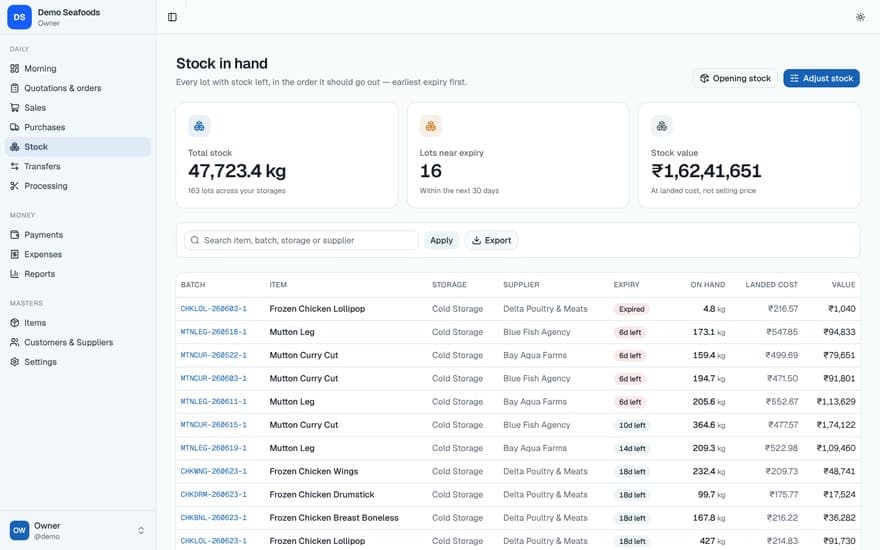
- Batch and expiry tracking with first-expiry-first-out stock issue across two storage locations
- Purchases with transport and packing costs folded into the landed cost per kg
- Delivery challans, GST invoices, credit notes and monthly consolidated billing
- Receivables, part payments and reports, including a GST working pack
03 / Under the surface
Implementation
Next.js and TypeScript on PostgreSQL through Drizzle. Stock is an append-only ledger, so quantity on hand is always derived from it. Documents are cancelled or reversed by credit note and never deleted. Money uses decimal arithmetic throughout.
Key engineering decisions
- Stock is an append-only ledger with no stored balance. Quantity on hand is always summed from movements, so it cannot drift from what happened. Cancelling a document writes the exact negation of its rows.
- Every sale line is stamped with the landed cost of the lot it came from, so profit per kg is a query, not a calculation engine. Transport, loading and packing costs are folded into each lot with an exact allocation that re-sums to the paisa.
- Stock is issued first-expiry-first-out. One requested quantity can span several lots, and each lot becomes its own document line, so cost stays honest when the same item was bought at different prices.
- Challans, invoices and credit notes share one table driven by two flags: moves stock, and creates dues. A monthly consolidated invoice bills existing delivery lines, moves no stock and carries no cost, so margin is never counted twice.
- Concurrent saves are serialised with per-item advisory locks taken in a fixed order, and GST document numbers are allocated inside the document's own transaction, so numbers are unique and gap-free for each financial year.
- Money is decimal end to end, in Postgres numeric columns and a decimal library in code. Financial documents are never deleted; they are cancelled, or reversed by a credit note, to match GST record-keeping rules.
The hard parts
- Processing: 100 kg of whole fish that yields 60 kg cleaned has to show up as a higher cost per kg on the output lot, so total cost in always equals total cost out.
- Supporting per-delivery billing and monthly billing from the same documents without counting cost or tax twice.
How it was checked
An integration script runs the full cycle against a real Postgres database inside a transaction that is rolled back: purchase, first-expiry-first-out sale, transfer, part payment and consolidated billing, with about 50 checks. Unit tests cover the money, date and CSV helpers.
04 / Delivery
What was delivered
A private client system. There is no public demo; client records, prices and source code are not shared here. Usage volume and time savings have not been published pending client confirmation.
Your next project